
Croatia
Istrian Coast: Rovinj, Pula & Poreč
Venetian waterfronts, Roman monuments, Byzantine mosaics, fishing harbours, hill towns, and a clear Adriatic coastline.
- Location
- Rovinj, Pula, and Poreč, Istria, Croatia
- Difficulty
- Easy
- Best season
- May to June or September
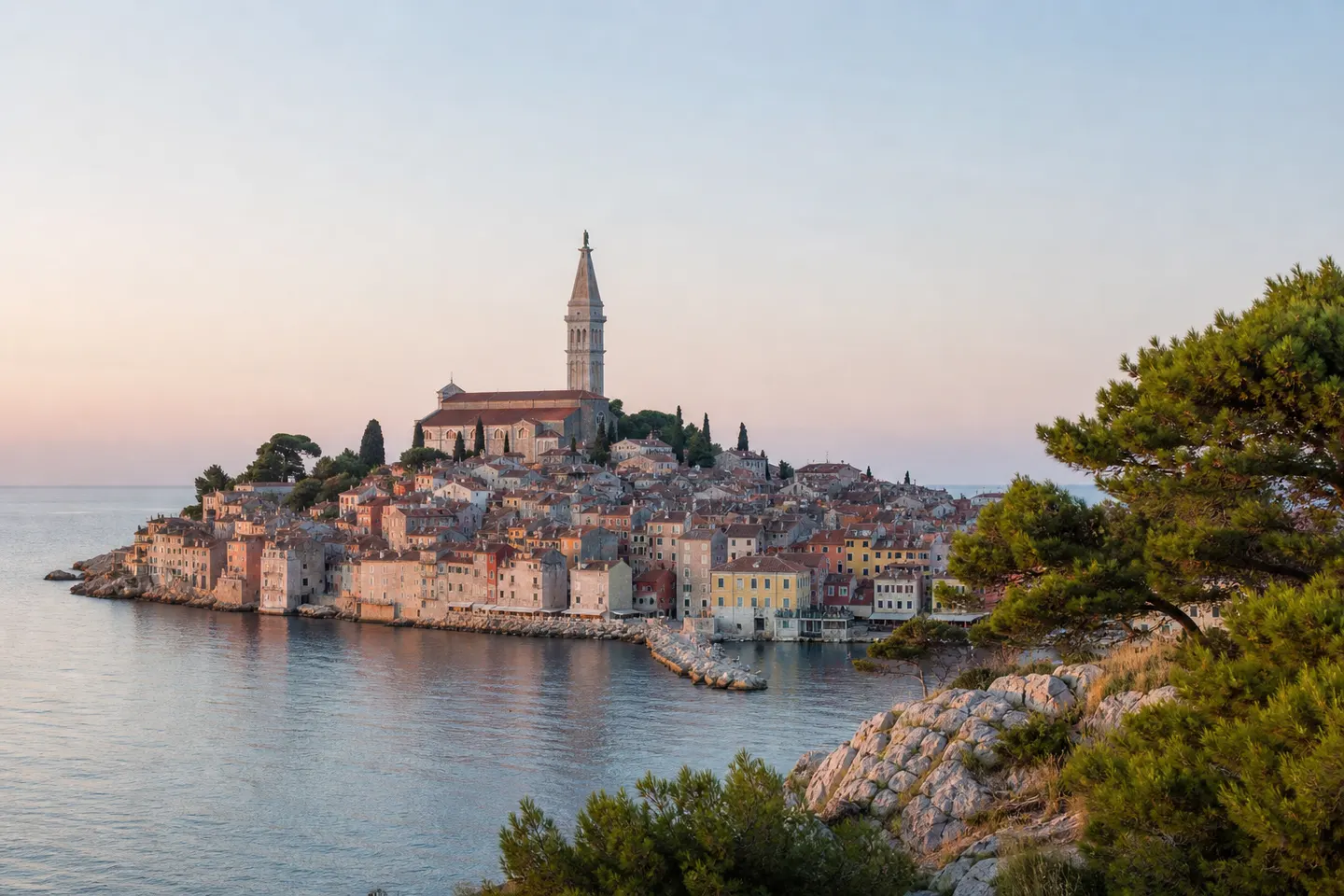
Rovinj’s old town rises from a compact peninsula, its stone lanes converging on the Church of Saint Euphemia and its tall bell tower. Former fishermen’s houses line the harbour, workshops occupy vaulted ground floors, and the waterfront changes character from working port to evening promenade. The nearby Golden Cape forest park offers shaded paths, rocky coves, and swimming areas.
Pula reveals Istria’s Roman past most vividly. Its remarkably complete amphitheatre dominates the city, while the Temple of Augustus, Forum, Arch of the Sergii, and archaeological collections fill out the story. South of the city, Cape Kamenjak protects low cliffs, coves, and Mediterranean vegetation; visitor controls and fire restrictions apply in busy or dry periods.
In Poreč, the Euphrasian Basilica complex preserves exceptional early Byzantine mosaics and is part of a UNESCO World Heritage inscription. The old street plan also retains Roman origins beneath later Venetian and Austro-Hungarian layers. Inland, Motovun and Grožnjan bring fortified hill-town views, galleries, truffles, olive oil, and vineyards.
The coast is mostly rock or pebble rather than sand, so water shoes can be useful. Try fuži pasta, seafood, Istrian prosciutto, truffles, Malvazija wine, and local olive oil. Confirm monument hours, protected-area access, and swimming conditions.
Pula reveals Istria’s Roman past most vividly. Its remarkably complete amphitheatre dominates the city, while the Temple of Augustus, Forum, Arch of the Sergii, and archaeological collections fill out the story. South of the city, Cape Kamenjak protects low cliffs, coves, and Mediterranean vegetation; visitor controls and fire restrictions apply in busy or dry periods.
In Poreč, the Euphrasian Basilica complex preserves exceptional early Byzantine mosaics and is part of a UNESCO World Heritage inscription. The old street plan also retains Roman origins beneath later Venetian and Austro-Hungarian layers. Inland, Motovun and Grožnjan bring fortified hill-town views, galleries, truffles, olive oil, and vineyards.
The coast is mostly rock or pebble rather than sand, so water shoes can be useful. Try fuži pasta, seafood, Istrian prosciutto, truffles, Malvazija wine, and local olive oil. Confirm monument hours, protected-area access, and swimming conditions.